·
3 min read
Telegram vs X vs Facebook impersonation policies compared
How Telegram, X and Facebook handle brand impersonation: what each policy covers, where companies report, and why outcomes and speed differ so much.


ChainPatrol
X and Facebook both have written impersonation policies and dedicated routes for companies to report fake accounts. Telegram does not: it relies on general scam and abuse reporting, with no brand or trademark portal. That difference in tooling, more than any difference in rules, is why the same fake support account comes down faster on X or Facebook than on Telegram.
Here's how the three compare. For what to do about the slowest one, see our guide to Telegram impersonation takedowns.
Side by side
X | Facebook (Meta) | Telegram | |
|---|---|---|---|
Written impersonation policy | Yes: misleading and deceptive identities | Yes: part of Meta's authentic identity rules | No standalone policy; scams prohibited in its terms |
Brand or trademark route | Trademark policy complaint | IP reporting, plus Brand Rights Protection for eligible brands | None |
Who can report | The company or an authorized representative | The business or an authorized representative | Anyone, through general channels |
Labeled parody and fan accounts | Allowed if clearly labeled | Allowed in some cases | No equivalent rule |
Typical outcomes | Suspension, or a required profile change | Removal | Ban, or a SCAM or FAKE label |
Published response time | None | None | None |
X
X's misleading and deceptive identities policy covers accounts that pose as another person, group or organization in a confusing or deceptive way. X says violating accounts are suspended or asked to update their profile, and it directs companies whose brand is misused to its trademark policy. We walk through both routes in how to report business impersonation on X.
Meta's rules require people to represent themselves authentically and prohibit impersonating others, including businesses. Companies can report impersonating profiles and pages, file intellectual property reports, and, if eligible, use Brand Rights Protection to find and report misuse of their brand at scale.
Telegram
Telegram's terms prohibit scamming users, but there's no dedicated route for brands. Reports go through the in-app Report option, the @notoscam bot and [email protected]. Accounts, bots, channels and groups are reviewed separately, and Telegram can mark an account with a SCAM or FAKE label instead of removing it. See how to report a fake support account on Telegram.
What this means for your team
On X and Facebook, a complete report through the right route usually decides the outcome.
On Telegram, persistence decides it: report every object, re-file with new evidence, and protect customers in the meantime.
On all three, block the link the fake sends people to. No platform policy covers the phishing site itself.
Frequently asked questions
Which platform removes impersonation fastest?
None of the three publishes a response time. In practice, complete reports on X and Facebook tend to resolve faster than Telegram reports, because those platforms have dedicated routes for brands.
Does the EU's Digital Services Act change Telegram's process?
Somewhat. See what the EU DSA changes for Telegram impersonation takedowns.
See where your brand is being impersonated across X, Facebook and Telegram with a free scan.
Sources
Accessed October 2026. Platform rules and processes change; check each source for the latest.
Fakes of your brand already out there?
ChainPatrol finds them, blocks the links in wallets and browsers, and files the takedowns for you.
More from The Impersonation Institute

Does Telegram have a trademark reporting form?
No. Telegram has no brand or trademark portal. Where impersonation reports actually go, what to include, and what protects customers while you wait.
Nikita Varabei
Telegram takedowns

How to report a fake support account on Telegram
Report each account, bot, channel and group separately, send scam reports to @notoscam, and email [email protected] for complex cases. What to include.
ChainPatrol
Telegram takedowns
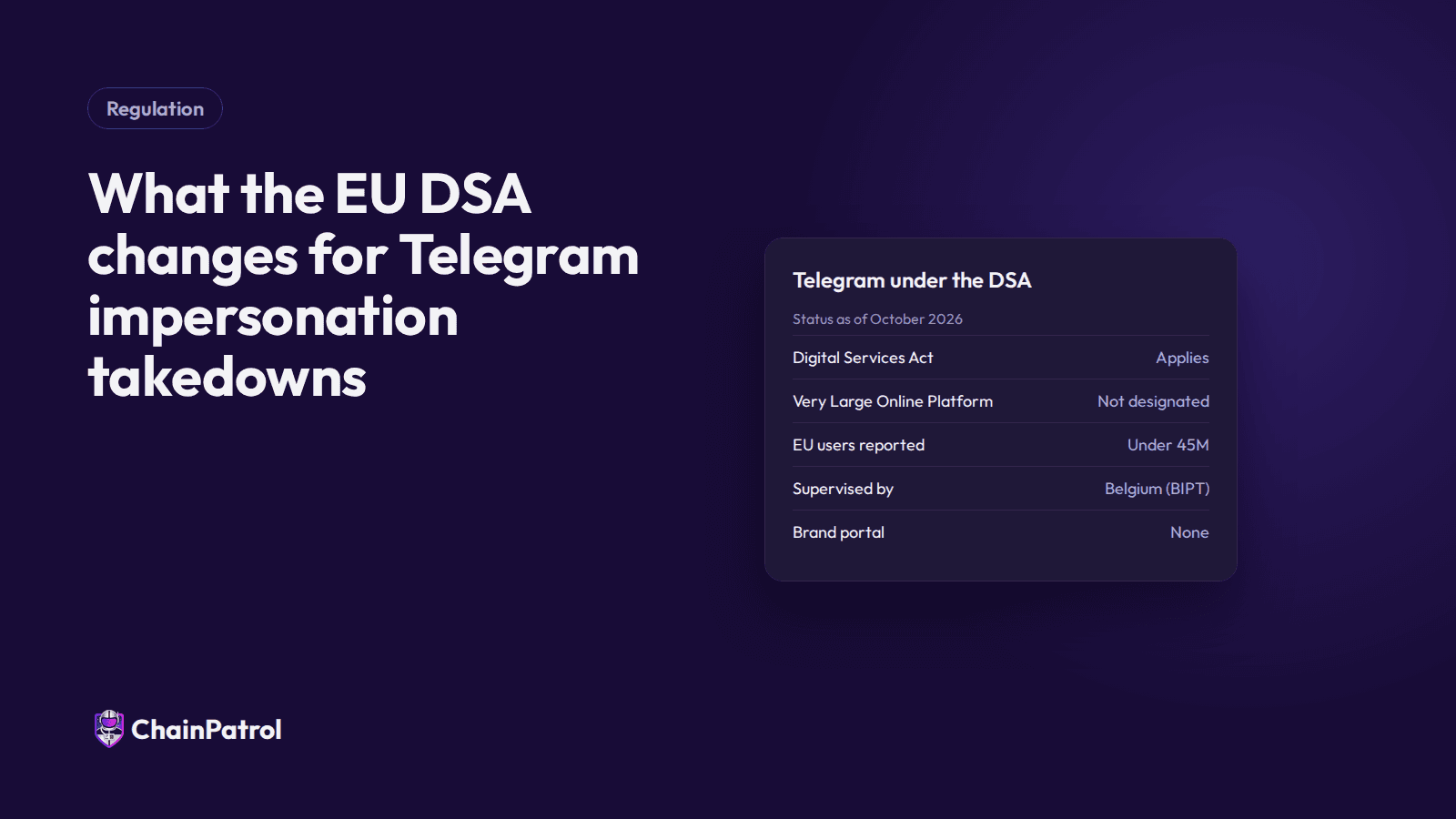
What the EU DSA changes for Telegram impersonation takedowns
Telegram isn't a Very Large Online Platform under the EU's Digital Services Act, but baseline duties apply. What that means for brands reporting fakes.
ChainPatrol
Telegram takedowns