·
3 min read
Fake support vs fan accounts vs parody: why platforms reject impersonation reports
Platforms reject impersonation reports when the account is allowed to exist. How X separates fake support from parody and fan accounts.


Nikita Varabei
Platforms reject a lot of impersonation reports because the account is allowed to exist. On X, parody, commentary and fan accounts are permitted as long as they label themselves clearly, so a report against a compliant one goes nowhere. A fake support account is different: it claims to be you and asks your customers to act.
Knowing where that line sits saves time on reports that were never going to work, and makes the ones that matter much harder to reject.
How X draws the line
X requires parody, commentary and fan accounts to say so in their account name and their bio, with words such as "parody", "fake", "fan" or "commentary", and not to contradict that with words like "official". X also offers a label these accounts can turn on. An account that meets the rules can use your name in conversation. One that doesn't may be asked to edit its profile or be suspended.
Account type | What it looks like | Reportable as impersonation? |
|---|---|---|
Fake support | Claims to be your company or team, asks customers to DM, click or pay | Yes |
Non-compliant fan or parody | Fan or joke account missing the required labels | Yes, but expect X to ask for edits first |
Compliant parody, commentary or fan | Labeled in the name and bio, doesn't claim to be official | No |
Same name, unrelated | Shares your name with no other connection to you | No |
The test we use
Does the account ask your customers to do something only your company should ask for? A DM about their account, a link to "resolve" an issue, a payment, a password, a seed phrase. If yes, it's fake support, whatever its bio says. If it just talks about you, even rudely, it probably isn't.
The gray areas
Former employees who still use your name in their bio.
Unofficial regional communities run by real fans in another language.
Resellers and affiliates who use your logo to promote your product.
None of these are scams by default, and reporting them can backfire. They need a decision from someone at your company. It's one of the few things a managed takedown service should always bring back to you rather than file on its own.
How to write a report that survives review
Quote the deceptive element: "Display name 'Brand Support', bio says 'official help desk'."
Show the harm: a screenshot of the reply asking a customer to DM or click.
Link your official account so the reviewer can compare.
Include proof you represent the brand.
Honestly, most rejected reports aren't wrong about the account. They just don't show the reviewer why it's deceptive. We cover the full sequence in how to report business impersonation on X.
Frequently asked questions
Should we report a fan account that criticizes us?
No. Criticism isn't impersonation, and a compliant fan or commentary account is allowed. Save reports for accounts that pose as you.
What if a parody account uses our logo?
If it's clearly labeled, an impersonation report likely won't succeed. Whether a trademark claim applies depends on how the logo is used, so check with counsel.
Do other platforms use the same rules?
Each platform draws its own line. The test is the same everywhere: is it asking customers to act as if it were you?
Want to separate the real fakes from the fans? Our free scan lists the accounts using your name, within 48 hours.
Nikita Varabei is co-founder and CEO of ChainPatrol. He spends most of his week with fraud and trust and safety teams dealing with impersonation of their brands.
Fakes of your brand already out there?
ChainPatrol finds them, blocks the links in wallets and browsers, and files the takedowns for you.
More from The Impersonation Institute
How to report business impersonation on X: impersonation vs trademark
X gives companies two routes: an impersonation report and a trademark complaint. Which to use for a fake brand or support account, and what to include.
ChainPatrol
Fake support accounts
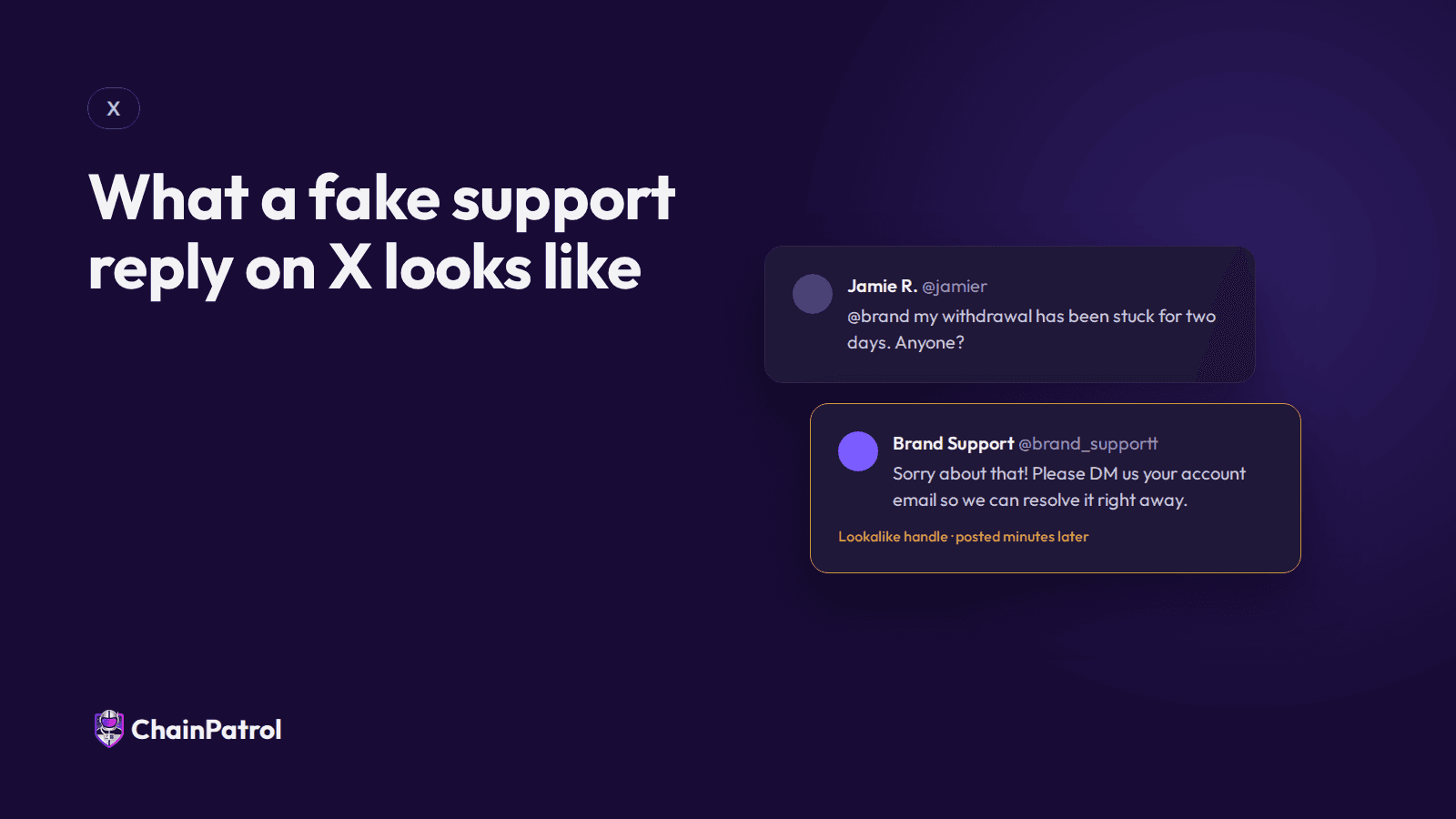
What a fake support reply on X looks like
Fake support replies arrive minutes after a complaint, look almost like you, and push for a DM or link. The anatomy, and the tells to teach customers.
Nikita Varabei
Fake support accounts

How long X takes to act on an impersonation report
X doesn't publish a response time for impersonation reports. What drives the wait, what we see in practice, and how to get a report acted on sooner.
ChainPatrol
Fake support accounts